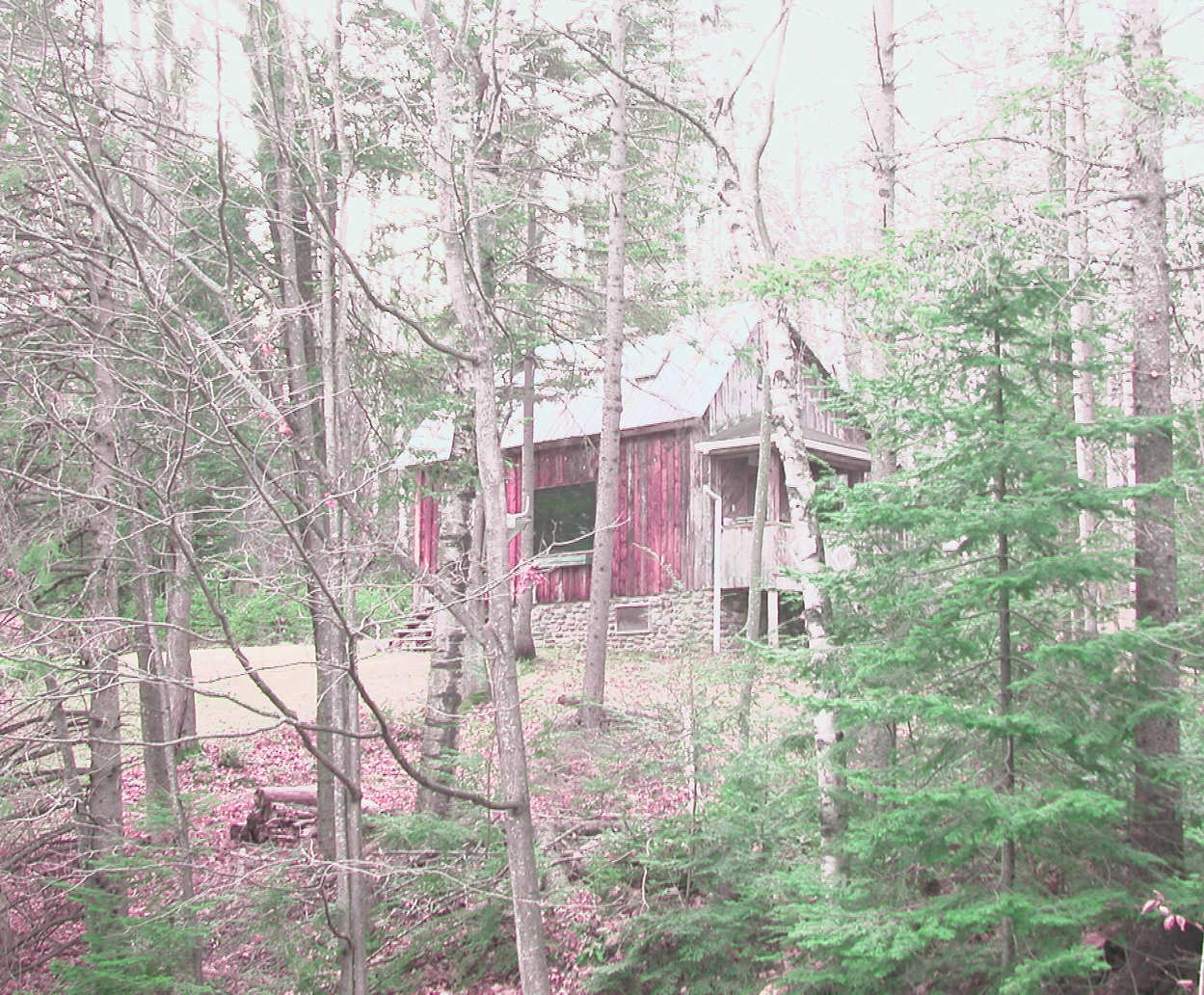

While still in the USAF in 1968 I purchased 80-acres of land on a ridge top high above Lake Massawippi in Southern Quebec. (Long story). The hillside terrain is exquisitely contoured and completely covered by softwoods and northern hardwoods that include a wide variety of species and many old stand trees. Seventy dollars an acre.
So, American buys land on Bunker Hill, Quebec, Canada. Bunker Hill (Colline Bunker) was probably named by Loyalists, many of whom made their way to Quebec's Eastern Townships during and after the American Revolution.
Honorably discharged in 1970, I then spent a year living and traveling in an old Ford Econoline that I turned into Home Sweet Home.
Spending time with new friends and traveling between Marin County and the Navarro River in Mendicino provided a steady stream of new outlooks and experiences.
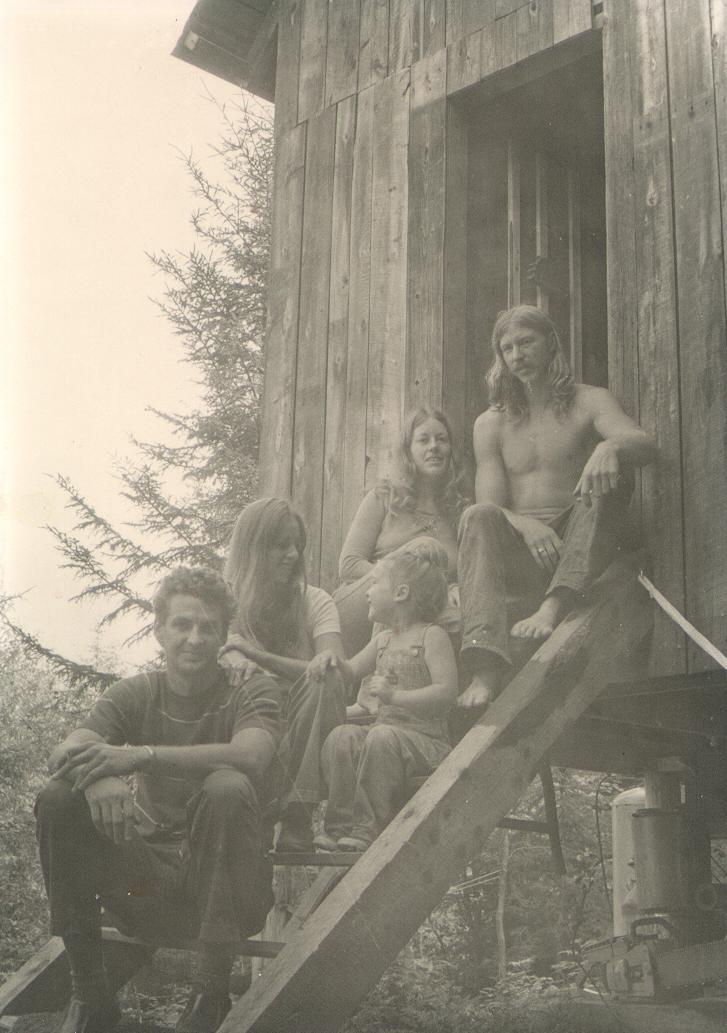
Then in February 1972, I along with Tania and Teag departed California to homestead on the land.
The trip East was an adventure in itself: snow storm in the mountains and sub-zero temperatures all the way across the mid-west. On the coldest night of the trip a gas station attendant kindly agreed to start the engine and let it run a few minutes every couple of hours in order to let us sleep through a night and not wake up to a frozen engine.
We moved onto the land on May 2nd and there was still nearly two feet of snow covering shady parts of the access road. Reclaimed lumber for our 10 x 14 tent platform was skid up the steep, winding road behind a borrowed Bultaco motorcycle, the only vehicle capable of making the climb outside of a skidoo.
We lived outdoors and slept in the tent, just 20 feet from the stream and the constant sound of the spring run-off. We cooked over an open fire with cast iron pans bought at farm auctions - buckwheat pancakes for breakfast and bannock prepared daily for meals and snacks.
As spring progressed we began eating off the land - fiddle heads and trout lilies at first, followed by strawberries and bull rushes, and finally blackberries, raspberries and wild mushrooms.
We spent nearly all our time outdoors and we saw the Northern Lights regularly.
In early summer I bought a standing post-and-beam implement shed for thirty-five dollars. We carefully demolished the shed and hauled the materials to the property in the hippy truck. The access road ended two-hundred feet short of the building site chosen for the cabin, so we hand-carried everything the final distance.
We layed out a 16' x 26' perimeter for the cabin and cut down the 3 or 4 trees within it. Next came 12 hand-dug holes for the cedar post foundation. Mattock, shovel, and iron bar were put to work on the hardpan with the goal of reaching a depth of four feet - the local frost line.
Four 16-foot beams were layed across four rows of three cedar posts to create the platform and the post-and-beam frame rose from there.
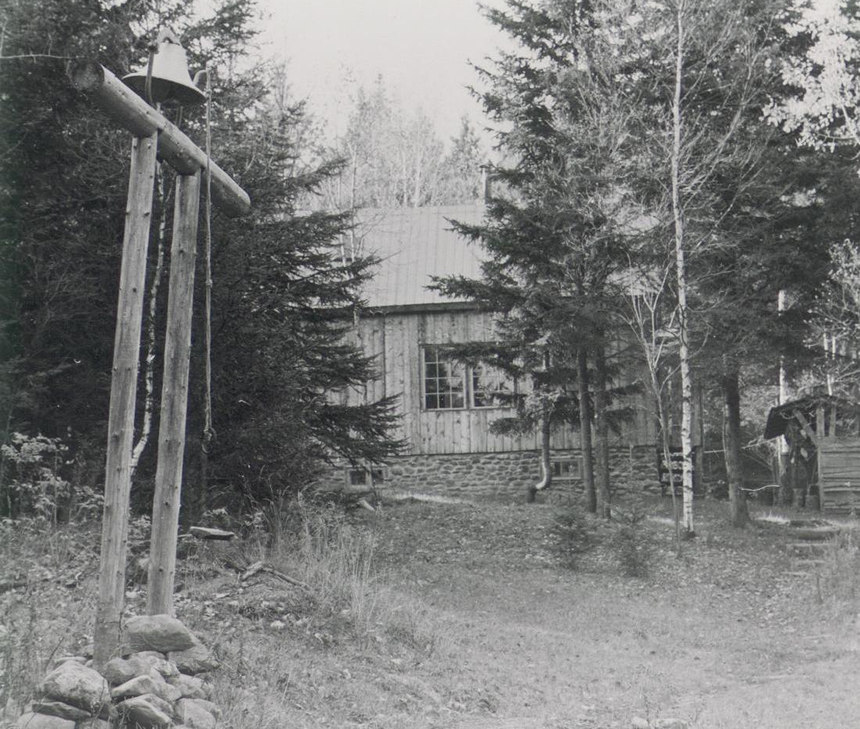
The windows were all single-glaze wood frame windows, including two from the previously demolished Ayer's Cliff train station. They were donated to us by the very kind-hearted Irene Keeble, cook at the Pigalle restaurant in town.
Great Uncle Bill's Kansas farm bell was put up on posts at the foot of the path to the cabin. The old train station windows are seen in the photo below, as well as newer siding applied later, and the tin roof that replaced the original tar paper covering.
I began laying up the double-wall fieldstone foundation on the fourth of July 1976 and finished during the second week of November. All the earth was excavated down to solid rock using pick and shovel and removed by wheel barrow. The most time-consuming part of the job was finding and transporting so much stone!
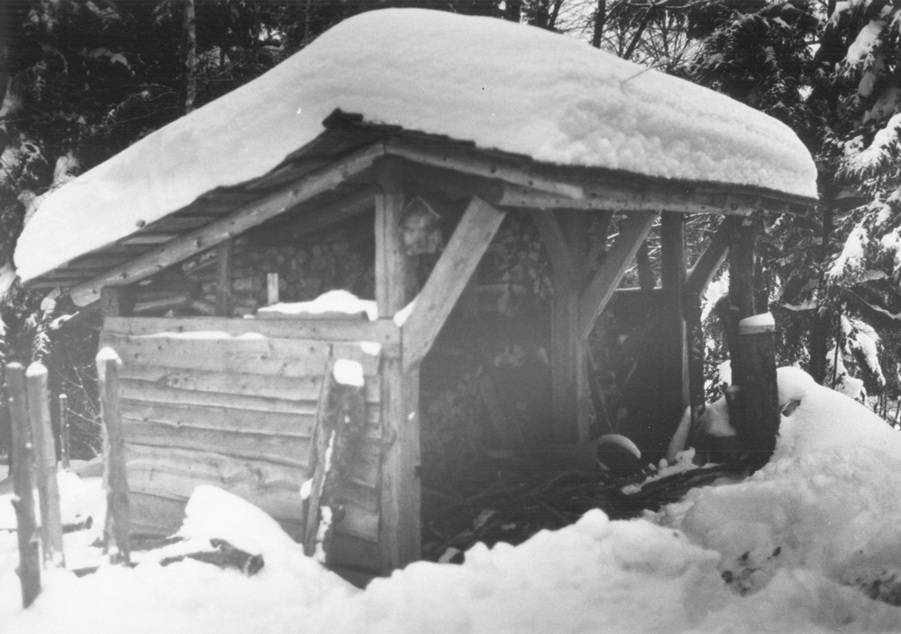
The auxiliary Woodshed shown below. This and the wood shed attached to the rear of the cabin could accommodate 5 solid cords (15 runs) of firewood, the average annual wood consumption for winter heat and year-round cooking on the kitchen stove.
Electricity and running water were still ten years away, so living in the cabin was truly a trip back in time. The only concession to modernity was a chain saw and the good old Case 430 tractor.
The easiest, most popular bathing method was a bucket and the rain barrel in the back yard. There is truly nothing so wonderful as bathing outdoors in nature. In late fall it was common to break the ice on the rain barrel, lather up and rinse with the bucket, and then madly dash inside to dry off in front of a hot wood stove.
Later, a pickup truck gas tank was reincarnated as an outdoor solar shower. Water flowed from the bottom of the tank by gravity so showers became warmer instead of cooler as the tank emptied.
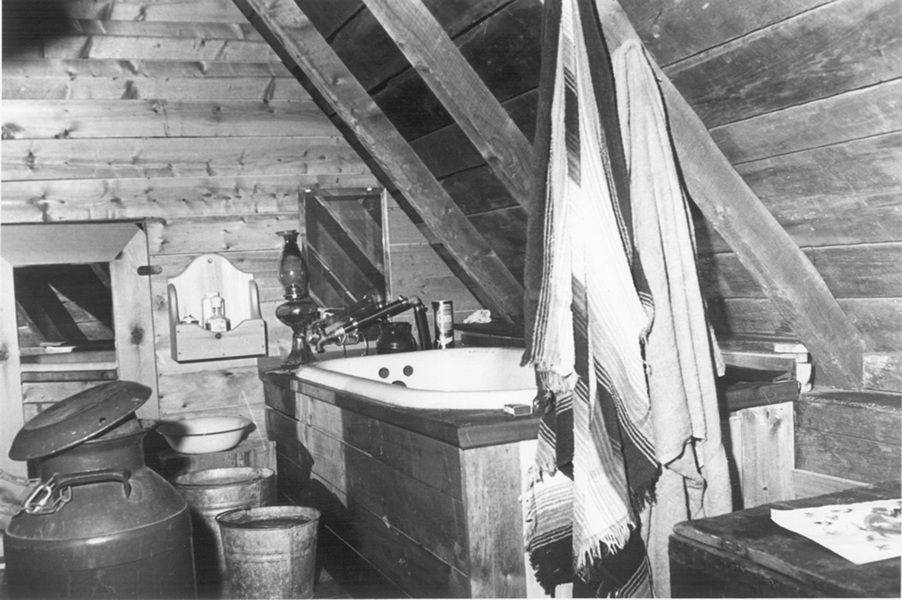
Winter bathing was accomplished using an old-fashioned farm bath. It was essentially a wash tub surrounded by an apron of tin. Sitting on the edge, one dipped water from buckets heated on the kitchen stove. Bath over, the entire contraption was lifted (grunt) over to the kitchen sink, where bath water was drained out via a strategically-placed drain in the tub.

Eventually, I installed an enormous bathtub up in the loft. It was so big that even I could stretch out and submerge myself. To fill it, pails of water were heated on the kitchen stove and poured into a milk can which was hoisted up to the loft with rope and pulley. Halfway up the milk can was given a good swing and then hoisted vigorously over the loft platform before being dropped to the platform on the swing with impeccable timing. Usually.
The first heating stove was a Quebec-cast, medium-sized box stove. It struggled to keep up with so much air infiltration in the cabin. Unless one rose a couple of times during the night to feed it more wood it was generally cold by morning.
The box stove, which went on to become the first sauna stove, was replaced with a PD Beckworth Number Six Round Oak, shown below. The Round Oak has a formidable heat output, and was an improvement in other ways as well: A) The ashes were removed from an ash compartment, not the fire box, B) The fire compartment was amply large, and C) It could be loaded from both the side door and the pot-lid in the top. Altogether this meant one could always depend upon a warm stove in the morning without sacrificing sleep or disturbing house cats.
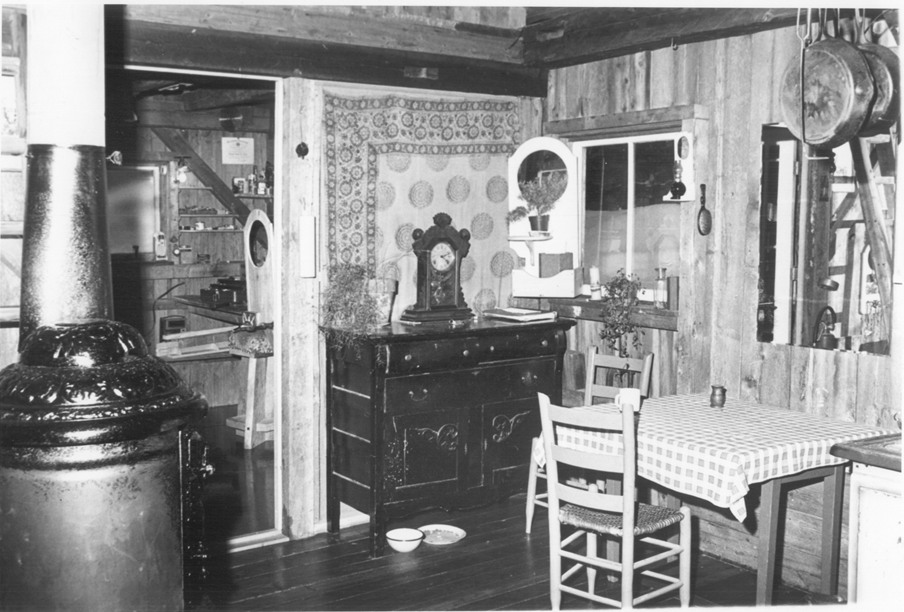
Eventually the Round Oak was a victim of its own success. Over the years as the cabin became better insulated and finished, the BTU comfort requirement steadily declined. Eventually the Round Oak's BTU output became excessive for the 416 square-foot cabin.
I sought a newer airtight-type wood stove to replace the Round Oak, and fairly quickly chose a Roxton Cadet, another Quebec-cast wood stove. Although front-loaders are not generally my first choice, the Cadet, as one such, is an exception. Even with front door loading and lacking the convenience of an ash pan, the Cadet does its job so well. Much of its success is probably due to its being well matched with the heating space.
My wood shop in the back room had an L-shaped bench beneath the southwest window. On the opposite wall were the cupboards that held the hundreds of jars of preserves I put up each year - vegetables, fruits, jams, jellies, and mushrooms.
The kitchen in 1975. Shown with the original wood cook stove. Purchased from Sandra Piercy in Ayer's Cliff in very used but usable condition, for $15.
The LeClerc was of a fairly common style of it's time: a yellow porcelain finish with gold accents and fogging. What made it so attractive was the particular shades of yellow and gold - very classy. It did have a mirror, but it's not installed in this photo.
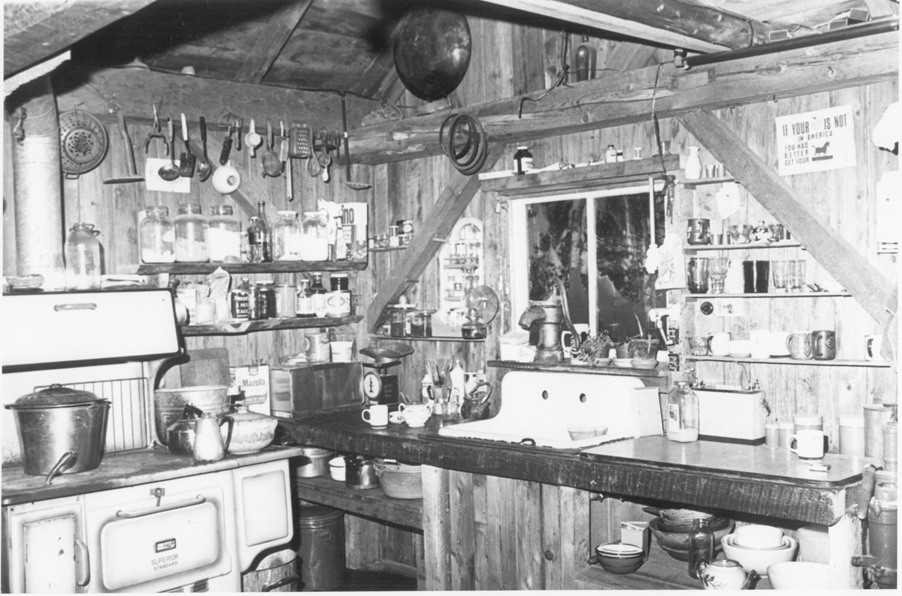
The pitcher pump in the kitchen window is a workout in disguise. Heavy stuff, water. It drew water from a shallow surface well dug to one side of the stream running by the cabin. Winter nights were bitter cold in those years, and it was crucial to always have a full pail of water available in the morning in case the water pump froze and had to be thawed out with hot water.
Kitchen and other home steading gear was abundant and cheap at local farm auctions. Big boxes of kitchen utensils went for fifty or seventy-five cents.
The wok shown hanging on the wall was plucked burnt and smoking off the trash heap in front of a San Francisco Chinatown restaurant, and rehabilitated.
The stainless steel pail on the stove was "liberated" from US Army supply by my lieutenant father in post-war Germany for my diaper pail when joined by my mother who gave birth to me there in 1947. Even after I ran over it with the tractor it's in daily service to this day.
The Root cellar behind the cabin was a 55-gallon drum dug into the earthen bank next to the stream. Before I dug the basement, it stored root vegetables like carrots and cabbage during winter months. During spring and fall it was my "refrigerator".

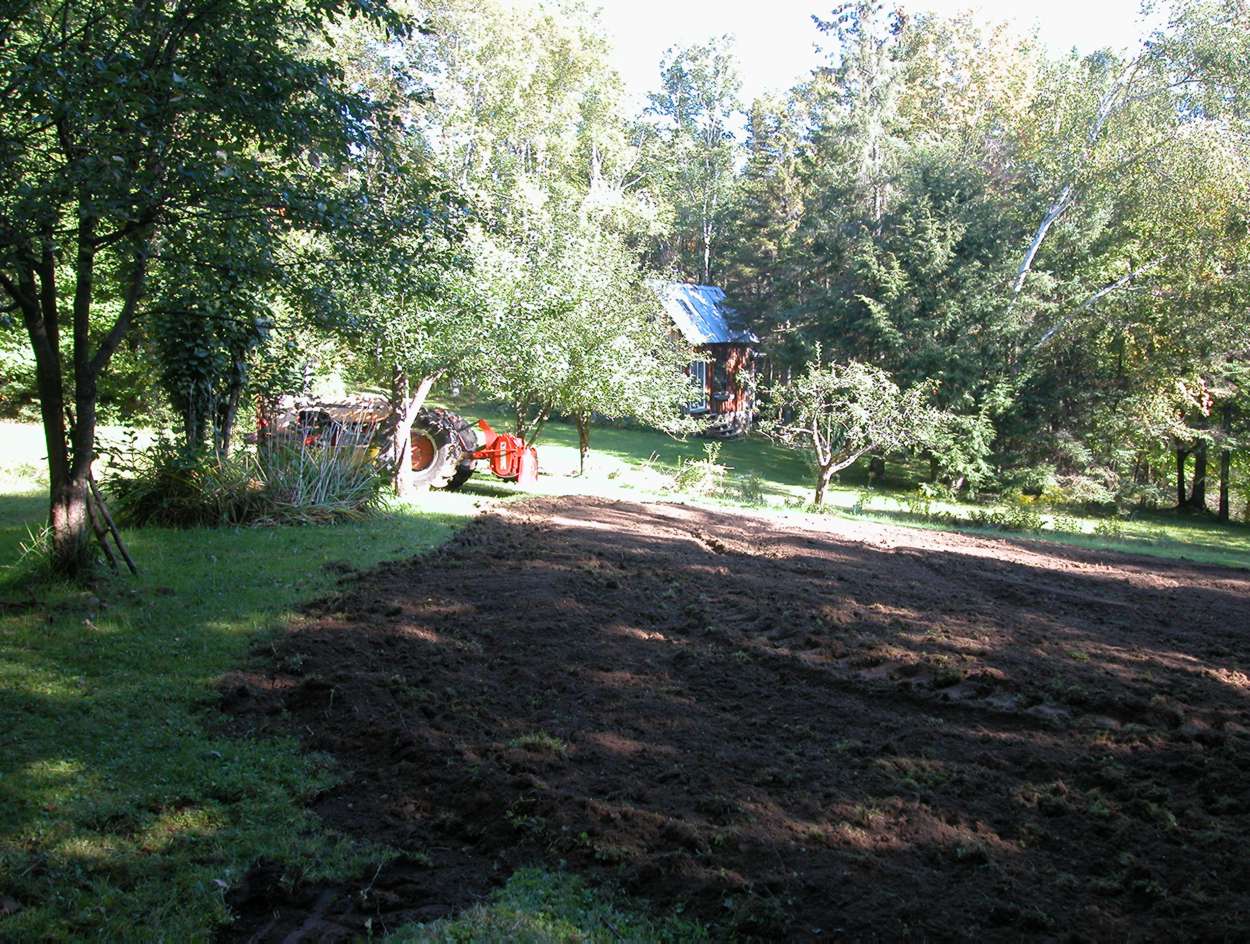
At the urging (insistence, really) of friend Jackie, I cleared the woodlot south of the cabin and planted an orchard. The initial planting was seven trees each of apple, plum, cherries, and pear. Each fruit group included at least two or three different varieties.
In spite of my attempts to keep wild cherry fire blight away from the orchard, the pear trees mostly succumbed to that fungus within a few years.
The plum trees never bore viable fruit, even after I added three more plants that made a total of five different varieties. Tiny fruits would appear, but always fall off. The plums did blossom profusely each spring, providing a heavy sweet scent that could at times be detected from surprising distances.
The cherry trees could be depended upon to bear abundant fruit nearly every year, but the trees died off after bearing fruit for around seven years.
The apple trees have survived and thrived, even over-coming a nasty wood borer infestation in their early years. They still bear the scars of that damage, but they are also bearing fruit prolifically at nearly 50 years.
Hydro Quebec connected the cabin to the grid on the twenty-third of December 1982, followed by Bell telephone on Christmas eve! Running water in the kitchen sink and upstairs bathtub followed early in 1983. But no self-respecting Hermit would use an indoor toilet, so the outhouse continued to serve that function. Complete annual cost of Hydro for the first year was one-hundred dollars.
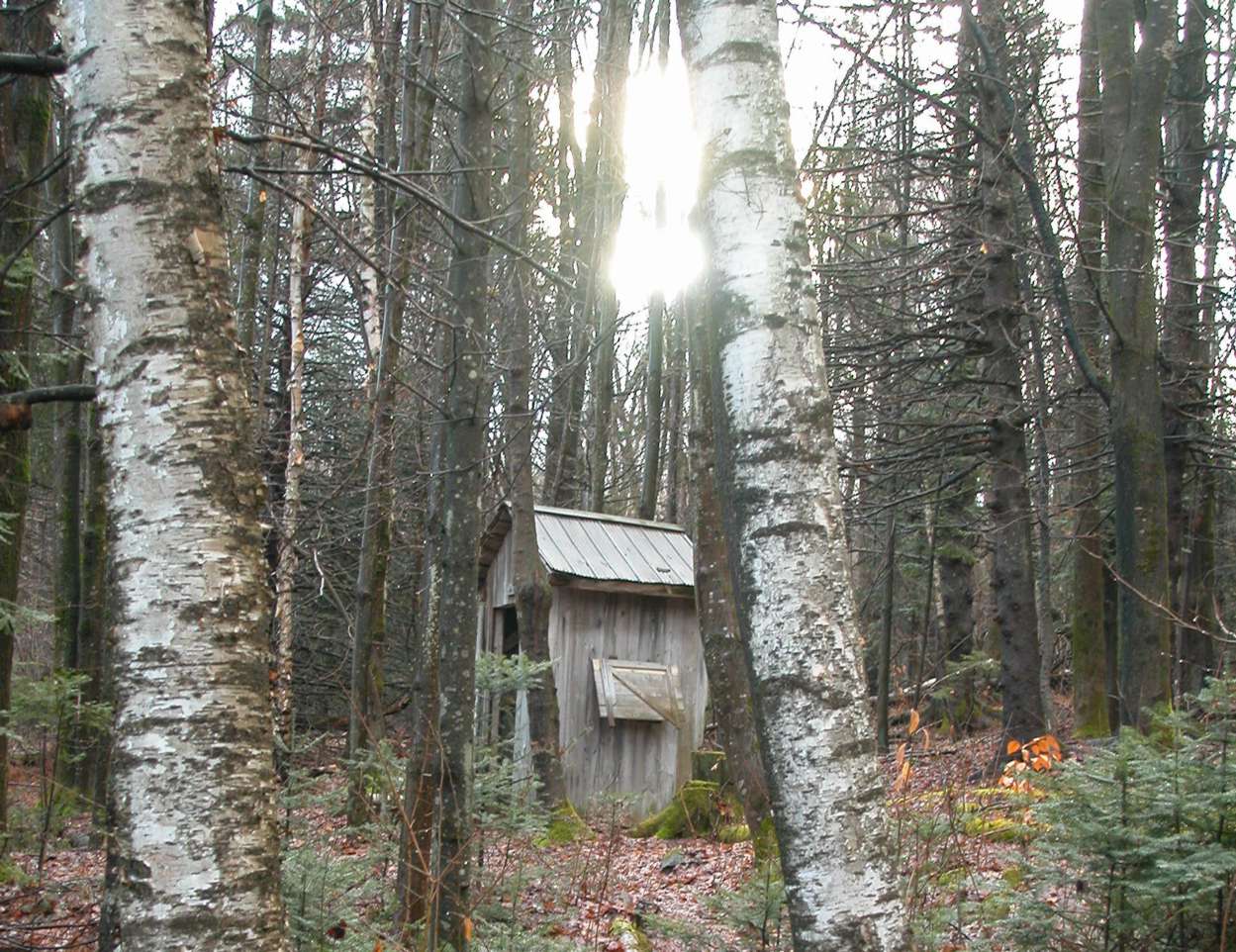
The good old outhouse! It's a two-seater: "Pilot" and "Co-Pilot" carved into the seating. So little need for privacy up here in the woods that when the door fell off one year I never bothered hanging it again.
The other animals are regular visitors to the outhouse and often leave behind their own modest deposits. More than once I've been joined by rabbits, red squirrels, and mice, unaware of my presence - until they were, at which time great panic usually ensued.
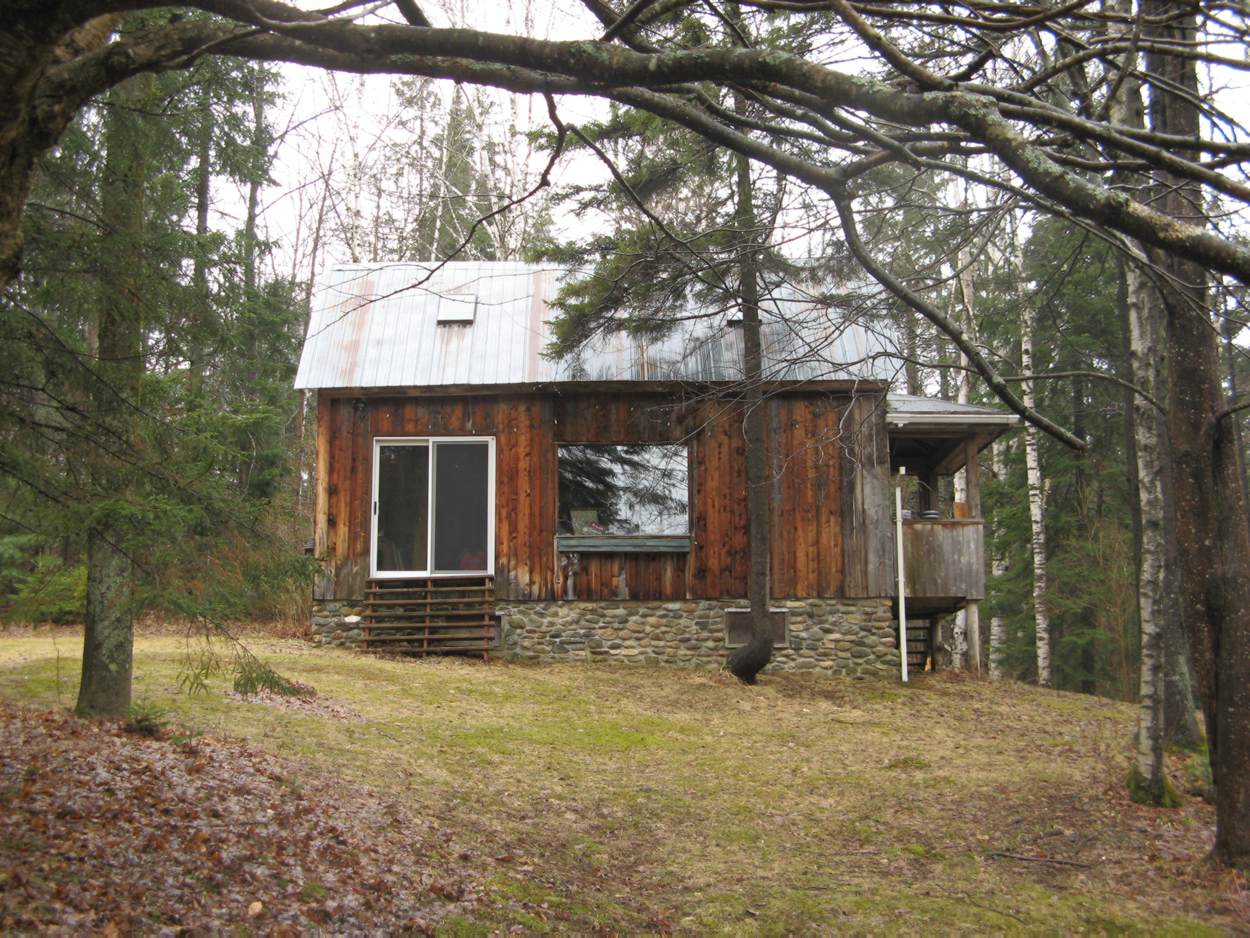
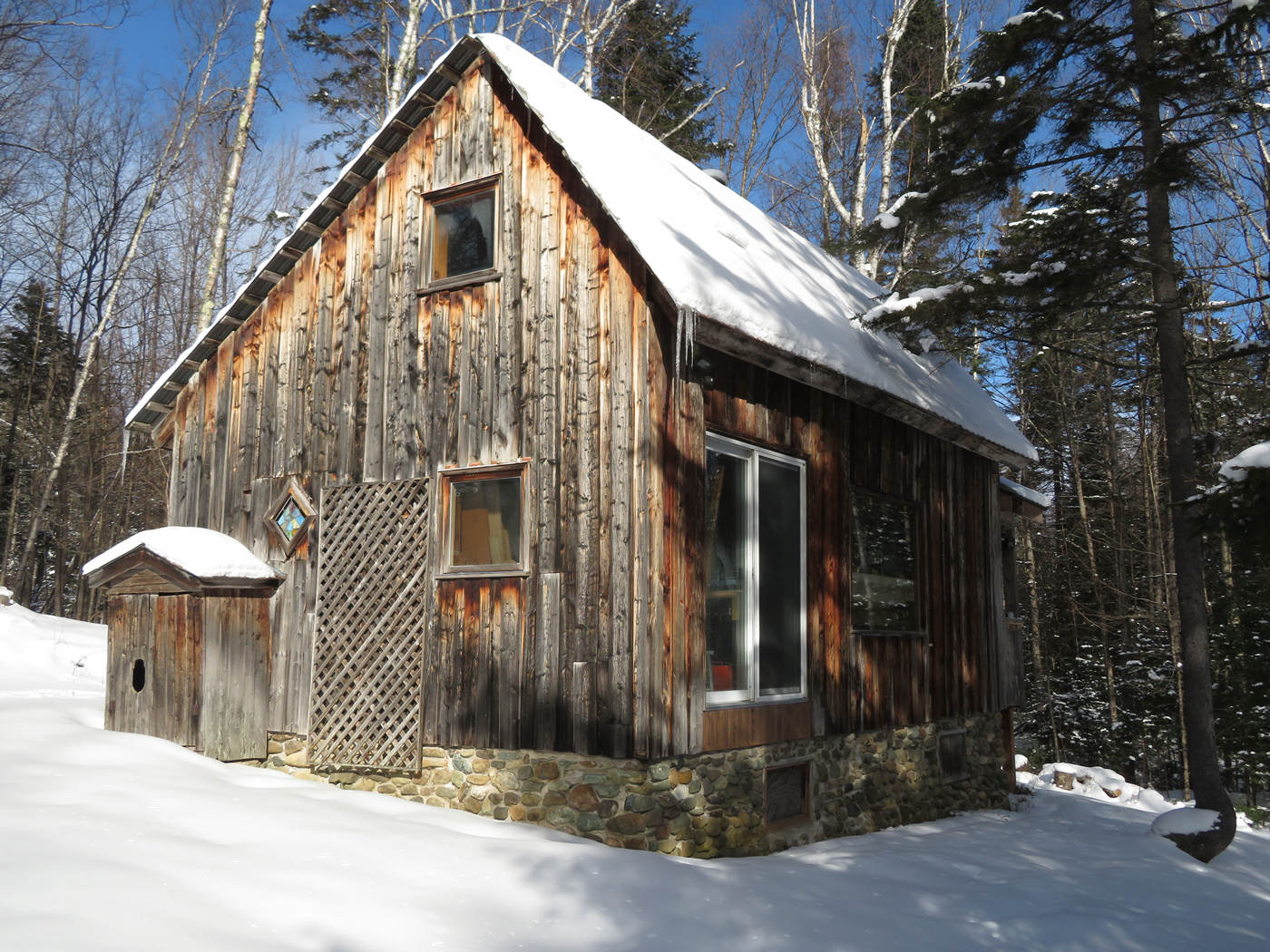
Below, The "modern" cabin with sliding door, thermopane picture window, and, by now, electricity and running water but still no indoor toilet. Never!
The cabin in winter. What a calm and tranquil place to get snowed in on a second date. Just ask, Liselyn.

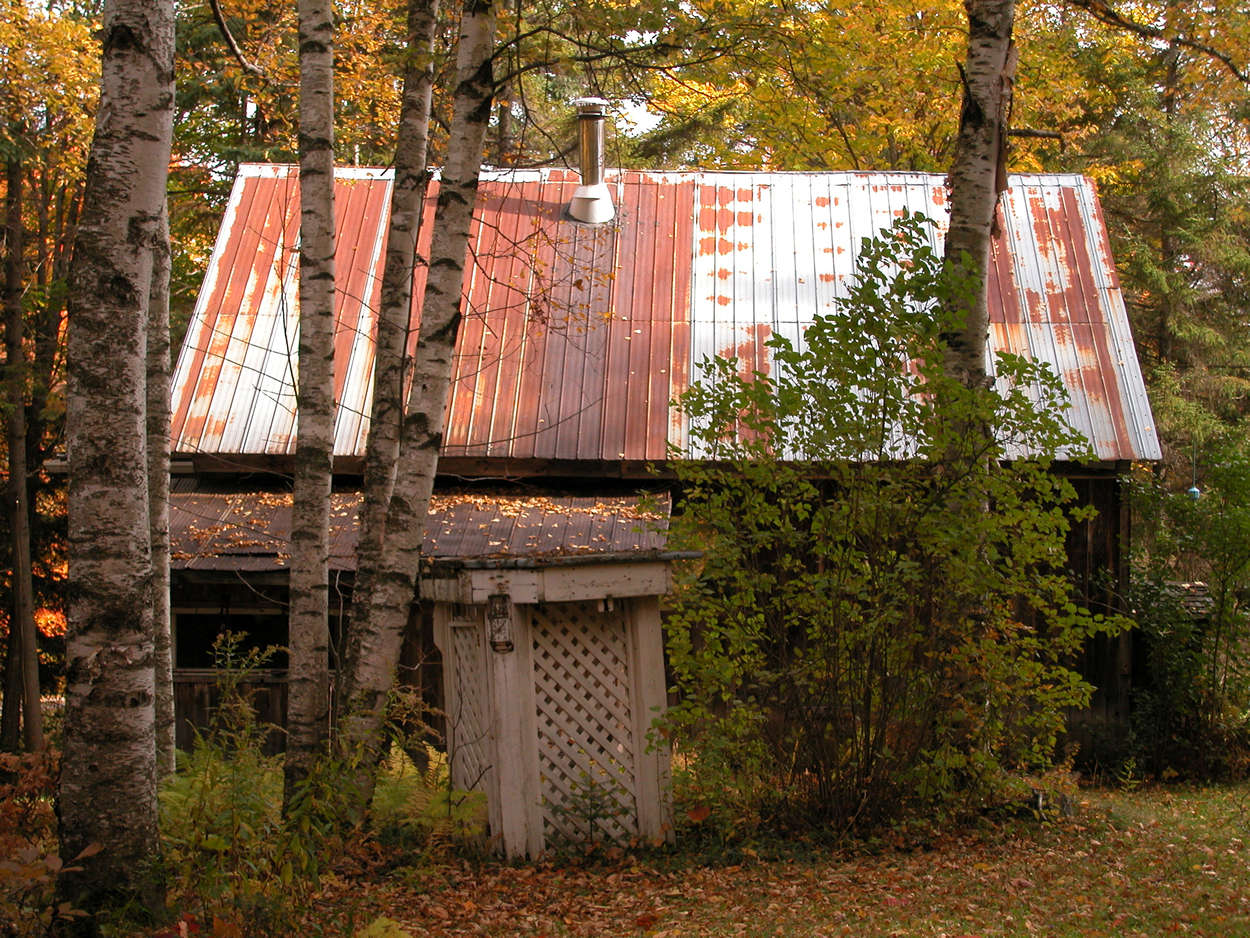
The back side of the cabin. Attached woodshed roof seen at left.
The cabin in snow, beneath a clear blue northern sky.
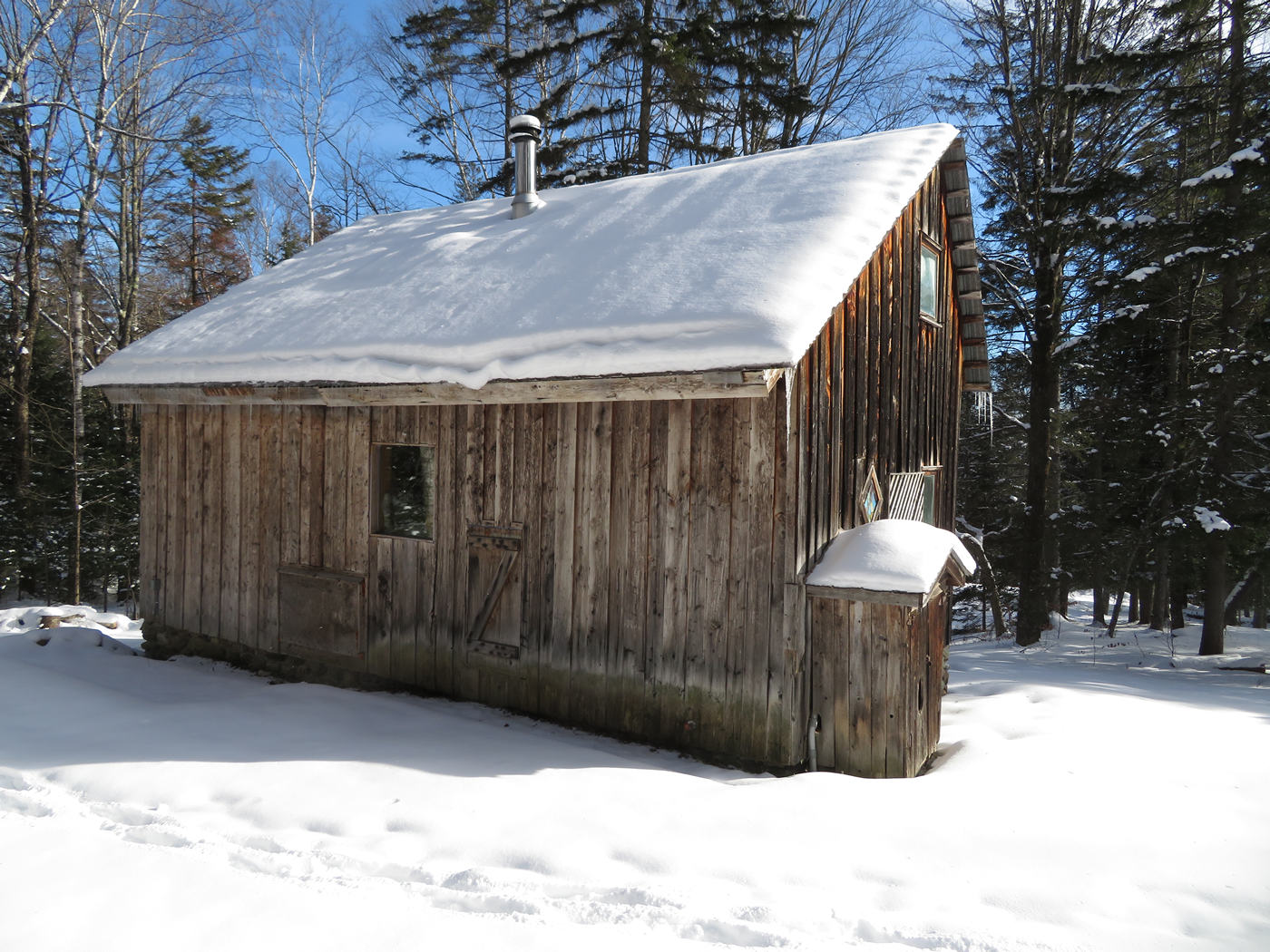
The small shed at left housed a generator that powered woodworking tools for a few years before electrification.
La Cabane en Rose.